Splitter
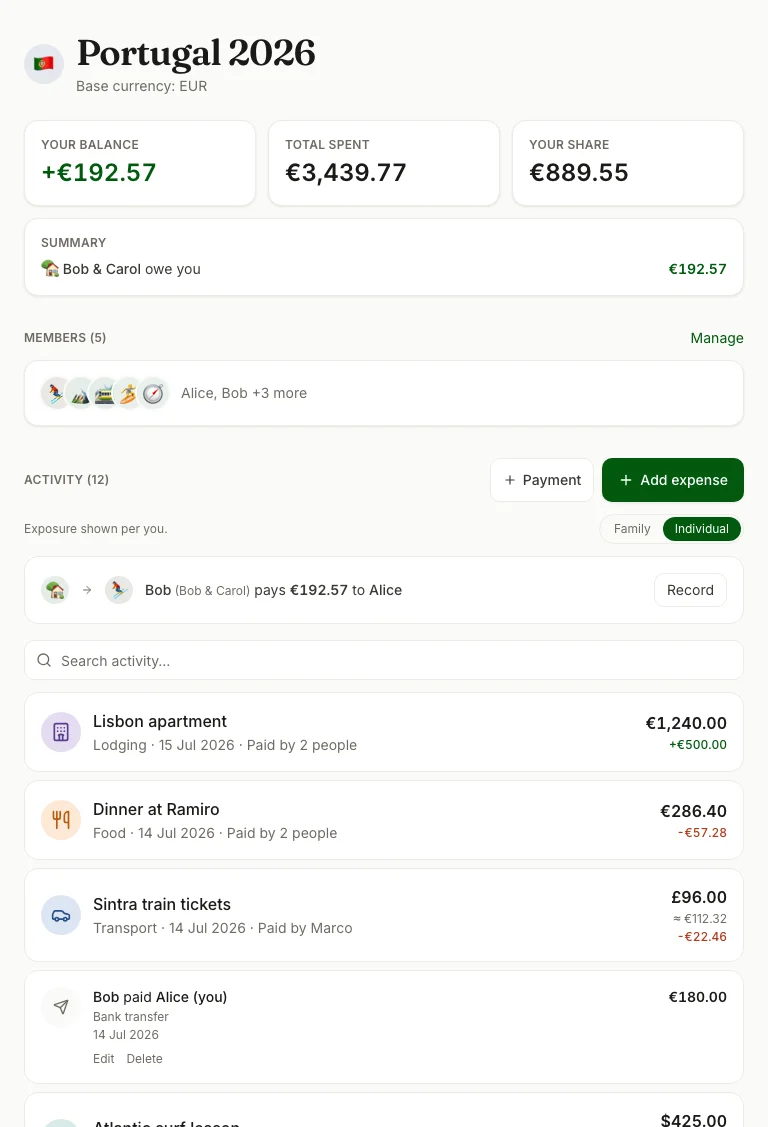
A trip can involve several currencies, shared bills and people paying for different things. Splitter keeps those expenses in one ledger and works out the remaining balances.
Let families settle together.
Four people, two households, CHF600 in shared expenses.
- DanAliceCHF 120
- BenClaraCHF 40
Each person settles their own balance.
- Clara & DanAlice & BenCHF 80
Each household settles one combined balance.
See the balances
| Person | Paid | Balance |
|---|---|---|
| Alice | CHF 270 | +CHF 120 |
| Ben | CHF 110 | −CHF 40 |
| Clara | CHF 190 | +CHF 40 |
| Dan | CHF 30 | −CHF 120 |
Positive balances are owed money. Negative balances owe money.
Why I built it
I wanted an alternative to Splitwise’s free tier. Splitter also became a way to learn how to ship a web app, deploy a backend and work with an AI coding agent.
How it works
Each trip has its own participants and base currency. An expense can have several payers and can be split equally, by exact amounts, by percentages or by shares. Receipts stay with their expenses.
The app suggests payments to settle the outstanding balances. People record those payments in the ledger; they make the transfers themselves.
A few decisions
I added family-based settlement so a household can settle as a unit. Individual expenses still belong to the people who paid them, but suggested payments use each family’s combined balance.
Unpaid balances can carry into a later trip as opening balances. That means a group can keep travelling together without having to settle every last amount between trips.
An optional AI comment reacts to a newly added expense with a short quip. It adds a little group-chat humour to the ledger; the balances come from the expense calculations.
Keep the history consistent
Exchange rates are saved when an entry is made, so later rate changes do not rewrite the trip’s history. A finished trip can still have unpaid balances. Keeping those states separate makes it possible to finish recording expenses and settle up afterwards.
Current status
A working web application with trip ledgers, expense entry, balances and recorded settlements. The image shows an isolated demo trip.